Advent is the season when many churches wait for Christmas. They wait by reading the promises that come before it. This plan gives you 24 short readings, one for each day from December 1 to December 24. It starts in Isaiah, moves through the birth stories in Matthew and Luke, and ends with John 1 on Christmas Eve. Each day has one question to carry with you. Most days take only a few minutes.
In short
The plan runs from December 1 to 24, so it fits the calendar no matter when Advent begins in your church.
Days 1 to 6 read promises in Isaiah. Days 7 to 22 follow Matthew 1 to 2 and Luke 1 to 2. Days 23 and 24 read John 1.
Each reading comes with one question. You can write a short answer or think it over during the day.
If you miss a day, read the next one. The story still holds together.
What is an Advent Bible reading plan?
An Advent Bible reading plan gives you a set of passages to read in the weeks before Christmas. It reads the promises, then the birth. The point is to arrive at Christmas with the story fresh in your mind, not to cover a lot of pages.
Liturgical Advent does not have a fixed length. It begins on the fourth Sunday before Christmas. Christmas lands on a different weekday each year, so the season runs a little under four weeks in some years and four full weeks in others. In 2026, Christmas falls on a Friday, so Advent begins on Sunday, November 29. Eastern Orthodox churches keep a longer fast before Christmas, and some churches don't mark Advent at all.
This plan sets the church calendar aside and uses the ordinary one: December 1 to 24. If your church lights its first candle a few days earlier, use those days to read Isaiah 9 slowly before Day 1 comes around.
The plan covers parts of 11 chapters from four books. Isaiah has 66 chapters, Matthew 28, Luke 24, and John 21. You will read short portions from 6 of Isaiah's chapters, the first 2 chapters of Matthew and Luke, and the opening of John. If this is your first reading plan of any kind, the Bible reading plan for beginners offers a gentle way to build the habit first.
What do you read each day?
Here are the 24 readings. The question beside each one is a starting point. If you notice something else in the passage, follow that instead.
| Day | Reading | A question to carry |
|---|---|---|
| Dec 1 | Isaiah 7:10-14 | What sign does God give to a king who refuses to ask for one? |
| Dec 2 | Isaiah 9:1-7 | What changes for the people who walked in darkness? |
| Dec 3 | Isaiah 11:1-10 | What grows from the stump of Jesse, and what is it like? |
| Dec 4 | Isaiah 40:1-11 | Why does comfort come before the voice in the wilderness? |
| Dec 5 | Isaiah 52:7-10 | What news makes the messenger's feet beautiful? |
| Dec 6 | Isaiah 61:1-4 | Who receives good news in these verses? |
| Dec 7 | Matthew 1:1-17 | Which names in the family line surprise you? |
| Dec 8 | Luke 1:1-25 | What does Zechariah ask, and what happens to his voice? |
| Dec 9 | Luke 1:26-38 | How does Mary answer the angel in verse 38? |
| Dec 10 | Luke 1:39-45 | What does Elizabeth know before Mary says a word? |
| Dec 11 | Luke 1:46-56 | Whom does God lift up in Mary's song, and whom does he bring down? |
| Dec 12 | Luke 1:57-66 | Why do the neighbors wonder at the name John? |
| Dec 13 | Luke 1:67-80 | What does Zechariah say his son will do? |
| Dec 14 | Matthew 1:18-25 | What does Joseph plan before the dream, and what does he do after it? |
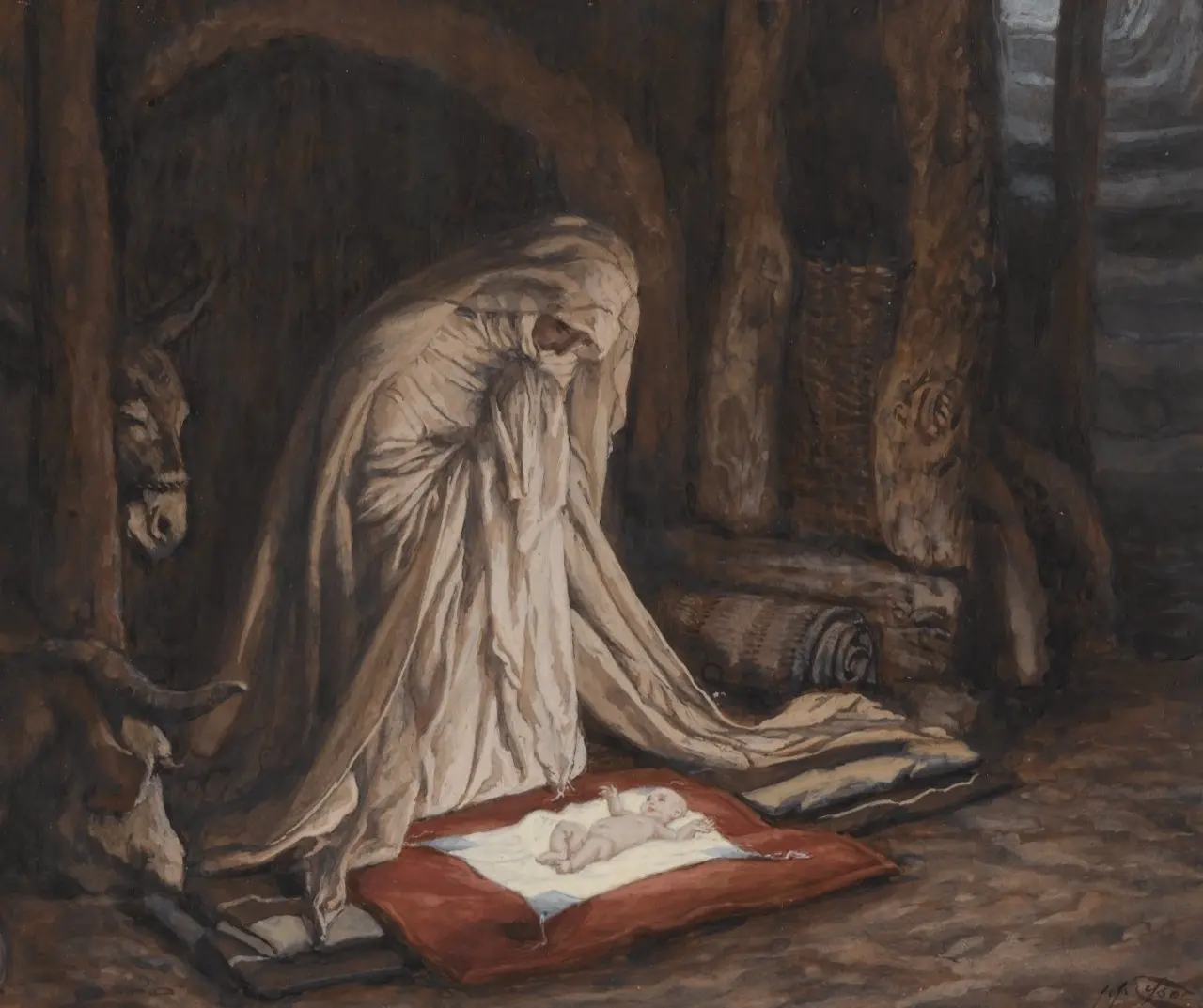
| Dec 15 | Luke 2:1-7 | Where does Mary lay her son, and why there? |
| Dec 16 | Luke 2:8-14 | Why does the angel tell the shepherds not to be afraid? |
| Dec 17 | Luke 2:15-20 | What do the shepherds do, and what does Mary do? |
| Dec 18 | Luke 2:21-24 | What do Mary and Joseph bring to the temple? |
| Dec 19 | Luke 2:25-35 | What has Simeon waited for, and what does he see? |
| Dec 20 | Luke 2:36-40 | Whom does Anna tell about the child? |
| Dec 21 | Matthew 2:1-12 | How do the wise men and Herod respond to the same news? |
| Dec 22 | Matthew 2:13-23 | Where does Joseph take the family, and why? |
| Dec 23 | John 1:1-13 | What does the light do in a dark place? |
| Dec 24 | John 1:14-18 | What does it mean that the Word lived among us? |
Twenty-four readings from Isaiah, Matthew, Luke, and John, December 1 to 24
The order follows the story rather than the order of the books. Luke and Matthew trade places a few times, because Matthew tells Joseph's side and Luke tells Mary's and Zechariah's. If you want to know why the order of reading changes what you notice, see what order to read the Bible in.
Why does the plan start in Isaiah?
Matthew and Luke both point back to the prophets. In Matthew 1:22-23, Matthew links the birth of Jesus to the sign in Isaiah 7:14. When you read Isaiah first, you hear the promise before you hear the gospel writers say it has come. Isaiah 9 is the center of that first week. It speaks of a child born to rule, and it gives him four names.
6For to us a child is born, to us a son is given; and the government shall be upon his shoulder, and his name shall be called Wonderful Counselor, Mighty God, Everlasting Father, Prince of Peace.
Read the verses around it too. Isaiah 9:2 speaks of people in darkness who see a great light, and Isaiah 9:7 says his government and peace will have no end. Keep that light in mind. It comes back on Day 23, when John 1:5 says the light shines in the darkness.
By Day 16 you reach the shepherds outside Bethlehem. The angel's news in Luke 2 gathers up what Isaiah promised. Notice the words Savior, Christ, and Lord, and the city of David, which takes you back to the shoot from Jesse in Isaiah 11:1.
10And the angel said to them, “Fear not, for behold, I bring you good news of great joy that will be for all the people.
11For unto you is born this day in the city of David a Savior, who is Christ the Lord.
How do you keep the plan through a busy December?
December fills up fast. A plan this short holds up best when you give it a set place in the day. Pick one: before breakfast, at lunch, or at the table after dinner. Read the passage once, then read the question, then read the passage again. The second reading is usually where you notice something new.
Write your answer in a sentence, not a page. On Day 11, for example, you might write down the people Mary says God lifts up in Luke 1:52-53. On Christmas Eve, look back over your 24 sentences. They tell the story the way you read it this year.
You will probably miss a day. Read today's passage and keep going. If you want the one you skipped, read it on the weekend. For more on getting back to a plan after a gap, see what to do when you fall behind. And if Christmas Eve's reading leaves you wanting more, John 1:1 explained walks through the opening line of John's Gospel in its setting.